
Jen’s EGPA Journey: Navigating a Rare Autoimmune Disease With Strength, Loss, and Hope
Jen felt steady and strong. She had goals—buying investment property in Brisbane, building community, staying active in her work in aged care. As a nurse, midwife, and lifelong caregiver, she had always been the one others relied on: dependable, energetic, rarely sick. She joked that she was the “Energizer bunny,” always moving, always supporting someone else.
But early this year, small signs began to suggest that something wasn’t right. Low-grade fevers. Numbness in her toes. Swelling in her face. A fatigue she couldn’t push through. She sought help, again and again, but no one could connect the dots. Over three months, she went to the emergency room four times. Each time, she was sent home with partial explanations but no answers.
Then everything changed.
Jen stood up from her bed, took a step, and collapsed. Her legs would not support her. She called her son, who immediately called an ambulance.
After days of tests, consultations, and specialist evaluations, Jen finally received a diagnosis: Eosinophilic Granulomatosis with Polyangiitis (EGPA)—a rare and potentially life-threatening autoimmune disease that causes inflammation in small and medium blood vessels. EGPA can affect nearly every organ system, and in Jen’s case, it had already caused significant nerve damage.
Getting a name for her condition was both validating and terrifying. “It was a relief because I knew it wasn’t all in my head. But it was also a shock—EGPA is so rare and so serious.”
A Long Road Through Hospitalization and Rehabilitation
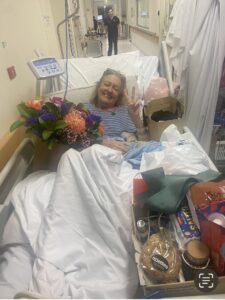 The diagnosis was only the beginning. Jen spent a month in the hospital and then three months in inpatient rehabilitation. EGPA had damaged the nerves in her legs so severely she had to relearn how to walk.
She worked her way from a wheelchair, to a walker, to a walking stick. The most stubborn challenge has been foot drop in her right leg, which makes it impossible to lift her foot properly. It remains one of the biggest barriers to complete independence and is currently preventing her from driving.
Her treatment plan has been intense: High-dose steroids, immunosuppressants, infusions to calm her overactive immune system. The medications come with difficult side effects, and infusion days are long and exhausting. This is living with a rare autoimmune disease.
Adjusting to a New Reality: The Invisible Weight of EGPA
Before her autoimmune diagnosis, Jen was constantly in motion—helping patients, caring for her grandchildren, staying involved in her community. Now, daily life requires caution and calculation.
Crossing the street, standing in the shower, walking through a store—these once-simple tasks now demand planning, pacing, and sometimes assistance. Using a walker in public has been especially challenging. “People look at me differently when I use my walker, like I’m suddenly less capable.”
The inability to drive has been one of the deepest losses. Not being able to hop in the car to work, run errands, or see her grandchildren has taken a major emotional toll. “Up until this year, I was such a big part of their daily lives. I feel like I’ve missed almost a year of their little lives.”
Despite everything, Jen remains grounded. As the youngest of eight children, she’s naturally independent. Asking for help still feels uncomfortable.
Falling Through the Cracks of the System
For many people living with a rare autoimmune disease, the hardest challenges extend beyond the body.
Since returning home, she has struggled to access formal support services. She is too young for aged care in Australia, not eligible for permanent disability benefits, and has had to privately fund home modifications for safety. “In Australia, we’re usually well looked after. But right now, I’ve slipped through the cracks.”
Despite these barriers, she continues fighting for stability. She practices walking, works on regaining strength, explores online business opportunities, and is preparing for a driving test using a left-side accelerator. “I don’t think I’ll pass next week,” she admitted. “But I’m trying not to overthink it. If I can’t drive yet, I’ll reassess again.”
Finding Community While Navigating Vulnerability
Another major shift has been the emotional terrain of living with a rare autoimmune disease. Chronic illness often comes with loneliness—especially when symptoms are invisible or difficult to explain.
Jen has joined EGPA and vasculitis support groups online. She gravitates toward communities that feel hopeful and constructive and avoids spaces that feel overly negative. “Finding someone who understands—who can say, ‘I deal with that too’—it’s like a lifeline.”
Still, local in-person support is limited. And conversations with family and friends can feel complicated. “I know how I used to respond when people talked about their ailments. I’m much more empathetic now, but I’m still mindful. I don’t want to be the downer in the group.”
What Jen Wants Others Living with an Autoimmune Disease to Know
Jen is still in the early chapters of her EGPA journey—still adapting, still recovering, still figuring out what long-term management will look like. But even from the midst of uncertainty, she offers wisdom that can resonate with anyone navigating an autoimmune disease:
“Be gentle with yourself. Your body is going through something you can’t always control.”
She believes in a balanced kind of optimism—not forced positivity, but honest hopefulness anchored in gratitude, trust in her medical team, and the love she receives from friends and family.
And when it comes to raising awareness, she is clear:
“There are over 100 autoimmune diseases. When we unite, our voices become stronger. Raising awareness together highlights the common struggles—delayed diagnosis, invisible symptoms, stigma, lack of research. We deserve better.”
A New Kind of Strength
Jen’s journey with EGPA is far from over. She is still rebuilding and still grieving the life she had before her autoimmune diagnosis. But she is also discovering a new kind of strength—one rooted in vulnerability, adaptability, and perseverance.
“I’ve learned I can’t plan for everything. I can’t speed anything up. But I can still live a life I’m proud of. I can still find beauty here.”
Her story is a reminder that survival itself is courage—and that telling the truth of our experience gives others permission to do the same.
Join our email list
Receive the latest blog articles, news, and more right to your inbox!
Related articles you might be interested in

How a Nobel-Winning Discovery Is Transforming Autoimmune Disease Treatment
Kristin’s Autoimmune Journey: Living With Unexplained Pain, Inflammatory Arthritis, and Hope
Becoming Her Own Advocate: Dimika’s Challenging Journey to an Autoimmune Diagnosis
Autoimmune Association Urges Federal Reform of 340B Program to Protect Patients
Find more resources on autoimmunity
Learn more about autoimmunity, diagnosis tips, how to find a physician, and more.